
THE DEFINITIVE HISTORY OF THE HIPPIE CAR
917-043
July 1970
Psychedelic dream machine
The Hippie Car started life as the third of the special, purpose-built SERA (Société d’Études et de Réalisations Automobiles) 917s and was built in June 1970, with the chassis number 917-043. After a test at Hockenheim, the car went to Le Mans.
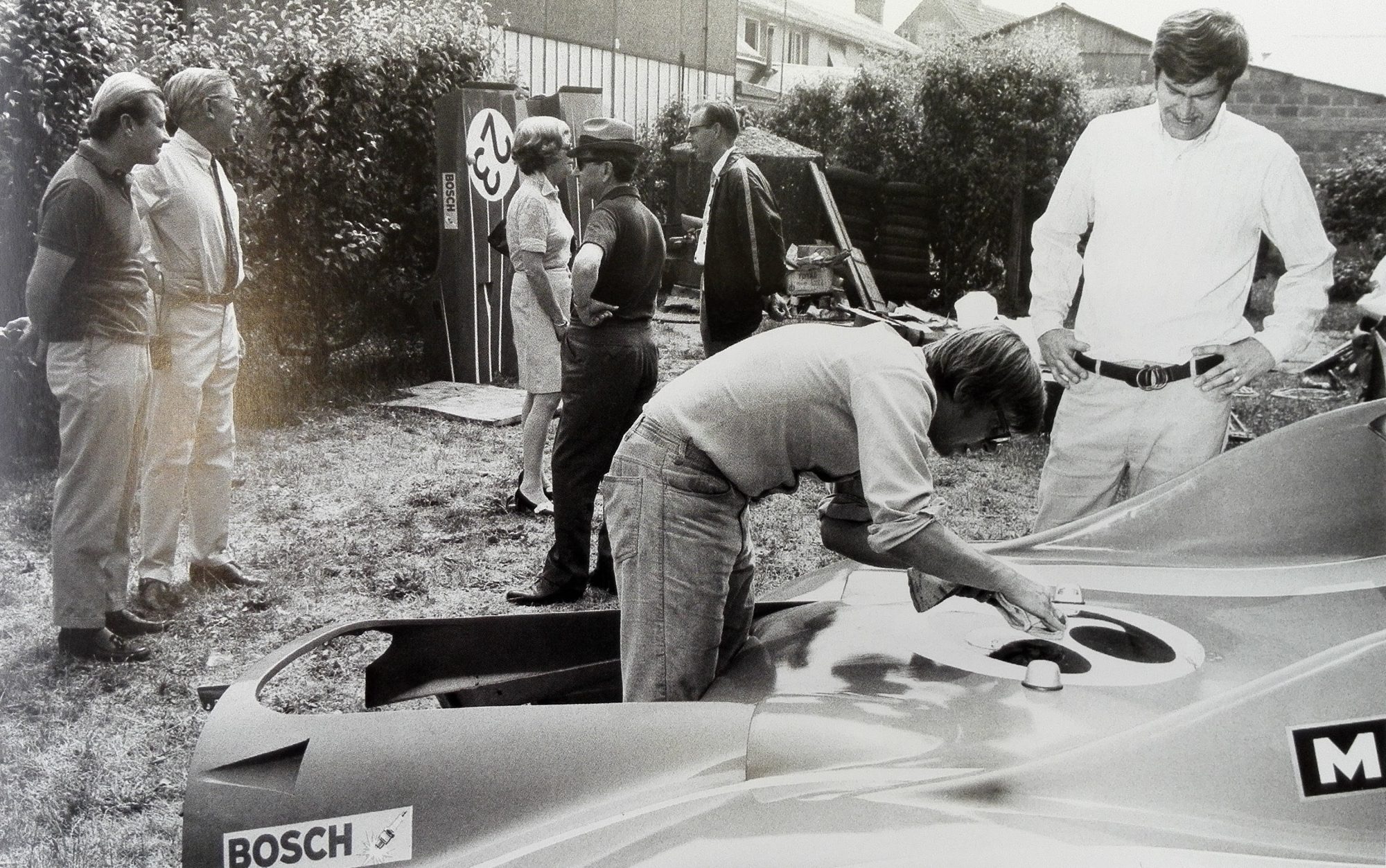
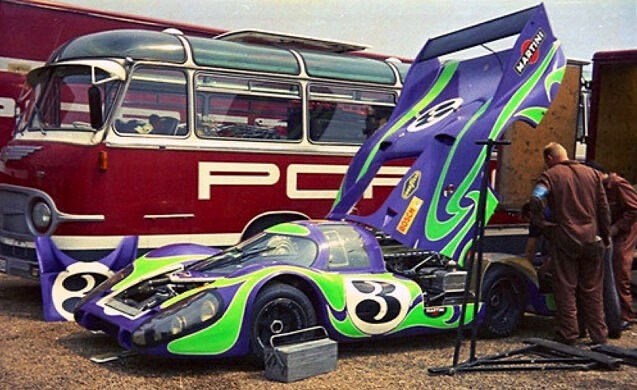
The car was destined to become part of the Martini Racing Team for Le Mans 1970 – the 917’s second year entering the notorious 24-hour race, following the car’s underwhelming debut in 1969. For this occasion, the car was painted in a special Martini livery at Le Mans by Porsche designer Anatole (Tony) Lapine and his assistant. Without the time to complete the design before practice, the livery initially comprised of bright violet whorls and swoops on a white body. The livery was unlike any other racing car that had graced the Le Mans grid.

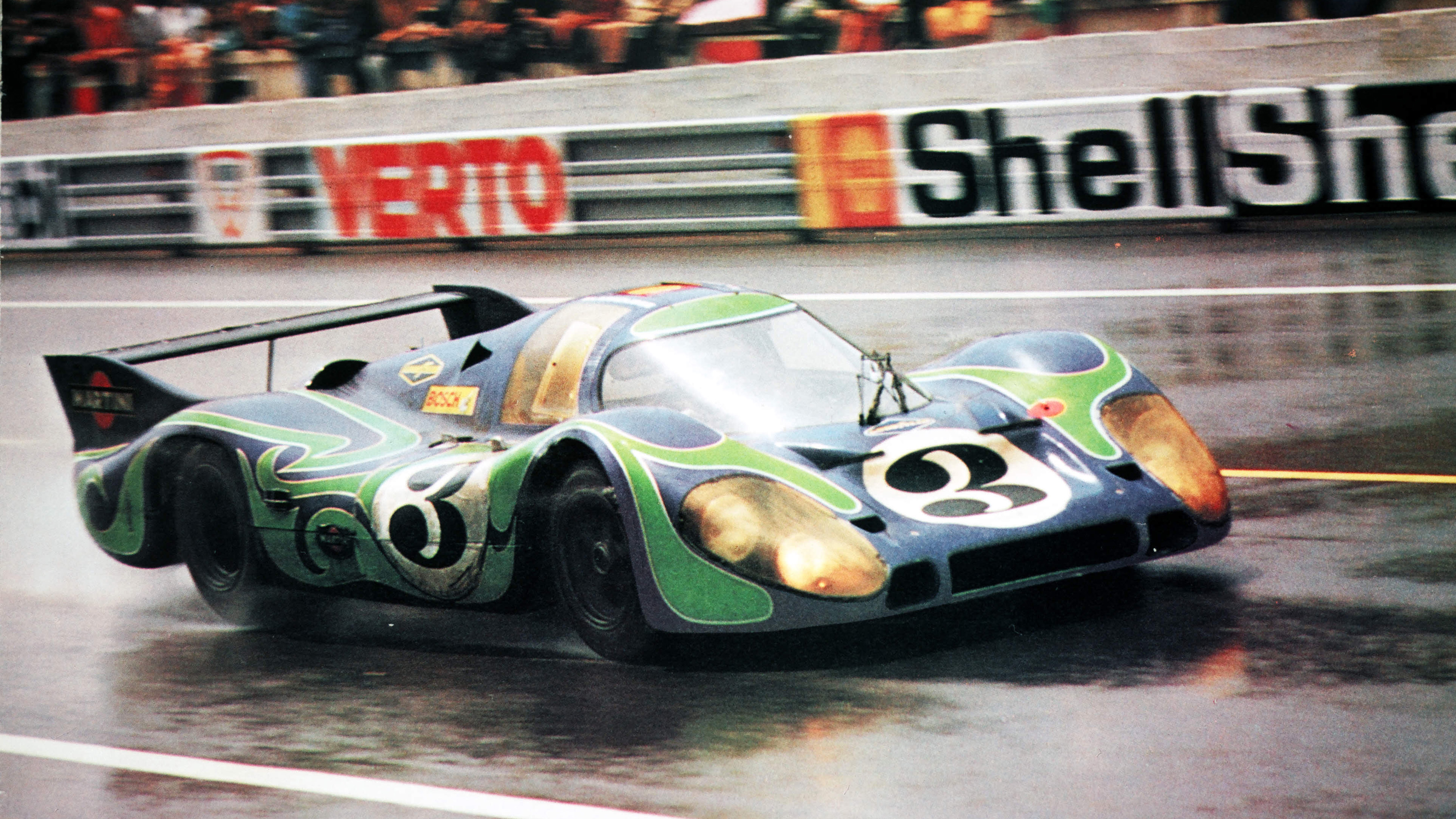
Porsche 917-043 in the Le Mans pit lane in 1970 before the addition of the bright green to the livery.
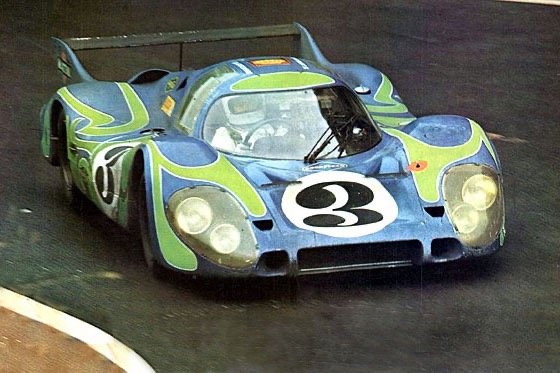
The car carried race number #3 and was driven by Gérard Larrousse and Willi Kauhsen for the Martini Racing team. The car qualified twelfth out of 57 cars but it was the Porsche 917 and Ferrari 512s that piqued the public’s interest.
On June 14, early in the morning before the start of 24-hour race, light green paint was added to complete the livery, giving a psychedelic twist that captured the attention of spectators and media alike, while inspiring a tradition of Art Car Specials. The psychedelic design reflected the Hippie influence at the time, similar to John Lennon’s iconic Rolls-Royce Phantom V, which was painted in a similar way in 1967.
The car was impossible to ignore and it wasn’t long before 917-043 was labelled ‘The Hippie Car’. As the race started, Larousse and Kauhsen got off to a solid start. Winning one position after the other, they were third after seven hours. By the twentieth hour, they reached second place – a position they maintained until the end of the race, despite the torrential rain and thunderstorms that plagued the treacherous nighttime hours.
By the end of the race, the Hippie Car had achieved second place overall, just behind Le Mans winners, Attwood and Herrmann in the winning 917-023 Kurz (short tail). The second-place finish was also enough to secure the coveted Index of Thermal Efficiency, thanks to the car’s lower fuel consumption. The car’s Le Mans 1970 participation is recorded on 917-043’s Porsche Build Record.

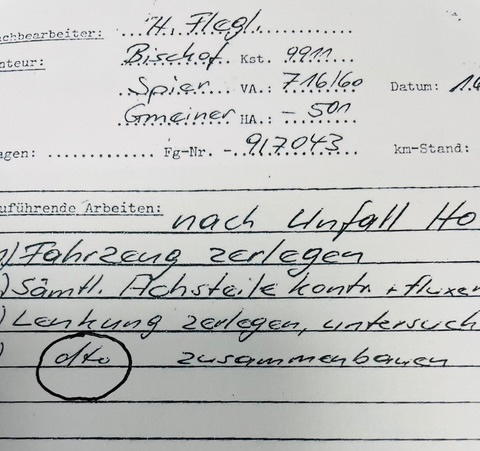
Repair note for 917-043 issued by Klaus Bishof, one of the few mechanics permitted to work on 917s in the early 1970s.
November 1970
A twist in the tale
Following its debut podium at Le Mans, the car was used in four testing sessions between July and November. On 13 November 1970 while testing at Hockenheim, 917-043 – driven by Siffert – was crashed. Despite rumours, the crash was light and caused by a rear wing failure.
Following the incident, Helmut Flegl (head of Porsche’s racing department) ordered 917-043 to be repaired, referenced in an internal document (left) instructing factory mechanics Bischof, Spier and Gmeiner to repair the car. Bischof went on to become the Director of the Porsche Museum in which capacity he confirmed the extent of the accident and repairs in 1998. He reiterated exactly what happened again when reunited with 917-043 in Stuttgart 2025.
July 1971
917-043 returns to Le Mans
For the remainder of the 1970 season, testing continued with a very modified SERA 917 for the attack on the 1971 Le Mans 24H race in which three of the special cars would race. The result was the ultimate long-tail 917 – a high speed concept still preferred by Ferdinand Piech, who remained convinced that the secret to success at Le Mans was high speed on the long Mulsanne straight.
917-043 retuned to Le Mans over the training weekend 17-18 April 1971. Painted plain white the car carried number 21 and completed 889kms driven by Jackie Oliver, Gijs Van Lennep, Derek Bell and Jo Siffert. Bell was due to race the car in that weekend’s Le Mans three-hour race but Porsche withdrew the car before the race.
Allocated to the JWAE (Gulf-Wyer) team, 917-043 was transported to the UK for preparation and during this process was given chassis number 917-009. Such changes were common when ATA carnets were required for cars crossing international borders. Obtaining carnets was bureaucratic and expensive, so JWAE changed the car’s chassis number to 917-009 because they already had a carnet for that 917, which had been damaged at Sebring earlier in the year.
The car was scrutineered as 917-009 as shown in the Le Mans Carnet de Pessage scrutineering documents. The change was effected by welding an additional chassis plate over the top of the original. This second plate was removed after the race, exposing the original chassis number 917-043. A picture of the car in the pit lane clearly shows the secondary chassis plate, while the original plate also had the remains of the second plate attached to it.
For Le Mans 1971 917-043 (009) carried race number 18 and was driven by British driver Jackie Oliver and Mexican Pedro Rodriguez. Oliver qualified the car in pole position, recording the fastest-ever top speed and lap time in the process, a record the car held for 37 years.
After a delay caused by a failed wheel bearing, car number 18 retired from the race in hour 14 due to the failure of the oil system (modified by Gulf-Wyer), who favoured external oil hoses rather than the oil running through the chassis tubes.
The SERA 917’s were purpose built for Le Mans and with the Group 5 regulation changes for 1972, they were now redundant. The chapter of 917-043’s life Le Mans had come to a close but it was far from the end of the car’s story.


Autumn 1971
Life after Le Mans
Retired from racing after the 1971 Le Mans, the fibreglass nose section of 917-043 was removed from the car and grafted onto a prototype 917/10-001 Can Am car for wind tunnel testing. Period pictures of that 917/10 in the wind tunnel clearly identify the nose as that of the 1971 Le Mans 917 long-tail that remained in its Gulf Wyer Team livery, retaining the race number 18. Before its sale to Vasek Polak in 1977, 917-043 was returned to its 1970 specification.
That same year, Vasek Polak sold 917-043 to his Brazilian client, Massimo Padrazzi, who had plans to remove the car’s roof and prepare it for the South American Interseries races. After realising the complexity and expense of racing a Porsche 917, Pedrazzi went in a different direction and built his own racing car called a Sabre D4, powered by a Porsche six-cylinder engine.
917-043 remained in his collection for 47 years, during which time the car was presumed ‘lost’, giving rise to other Porsche 917’s masquerading as the Hippie Car, such as 917-044 currently in the Simeone Foundation Automotive Museum, USA.
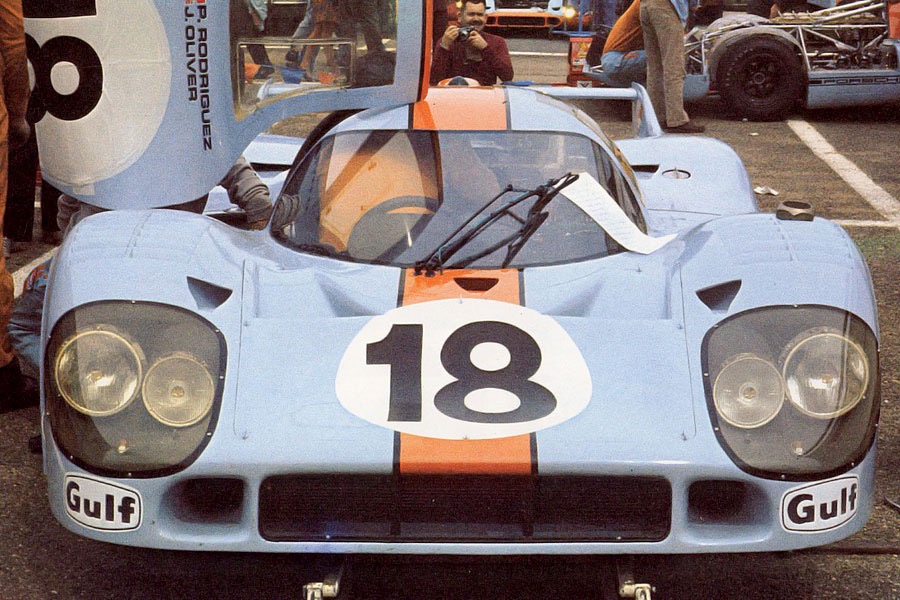
Period picture showing the fibreglass nose section grafted onto a prototype 917/10 Can Am car for wind tunnel testing (below), still bearing its Gulf Wyer Team livery after it had raced in the 1971 Le Mans (as seen above).


917-044, under Vasek Polak’s ownership after 1976, in plain white livery with number 917 and Vasek Polak lettering above the windscreen visor
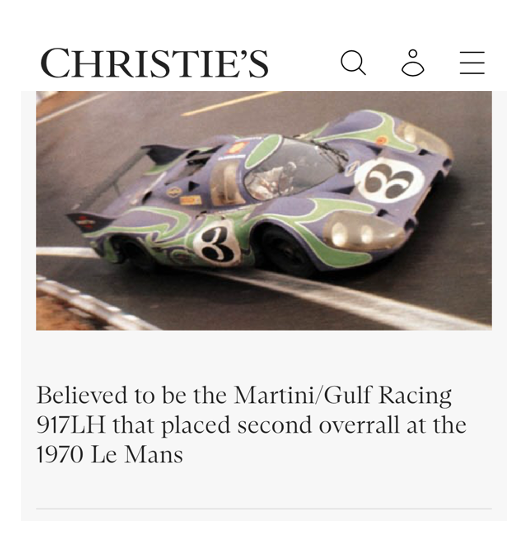
Screenshot of the auction listing for 917-044, offered for sale by Christies at the Monterey Jet Center auction in 1998. The incorrect image used in the listing was of 917-043 racing at Le Mans in 1970. Christies were unsure of the provenance of the car they were selling, which is reflected in the listing title, “believed to be the Martini/Gulf Racing 917LH”.
August 1998
Discovery of the true identities
In 1976/7 Vasek Polak also acquired 917-044, the partially built-up spare 917 SERA car from Porsche. Polak completed the car to a point where it could be driven and demonstrated. The car remained painted plain white and carried the number 917 and Vasek Polak lettering above the windscreen visor (left).
After Vasek Polak’s death in 1997, 917-044 was sold from the Polak estate to individuals working in the motor trade, who had the car the car painted in the ‘Hippie Car’ livery, in an attempt to deceive and pass off 917-044 as 917-043. The car (917-044) was then offered for sale at the Christies Pebble Beach auction in Monterey in 1998.
The auctioneers were unclear on the provenance of the car they were selling, which is reflected in the listing title for 917-044: “Believed to be the Martini/Gulf Racing 917LH that placed second overall at the 1970 Le Mans.”
The car did not sell under the hammer and a private treaty sale was later concluded with Dr. Frederick Simeone, who traded two cars for 917-044.
After it was acquired by Dr. Simeone, the car was later donated to the Simeone Foundation Automotive Museum in 2008. Since then, 917-044 has been incorrectly presented as The Hippie Car (917-043) that finished second in the 1970 Le Mans 24 Hours.
2024 Onwards
New owner, new era
After the sale by Massimo Pedrazzi to a private collection in 2024, 917-043 returned to Le Mans again for the Classic in 2025.
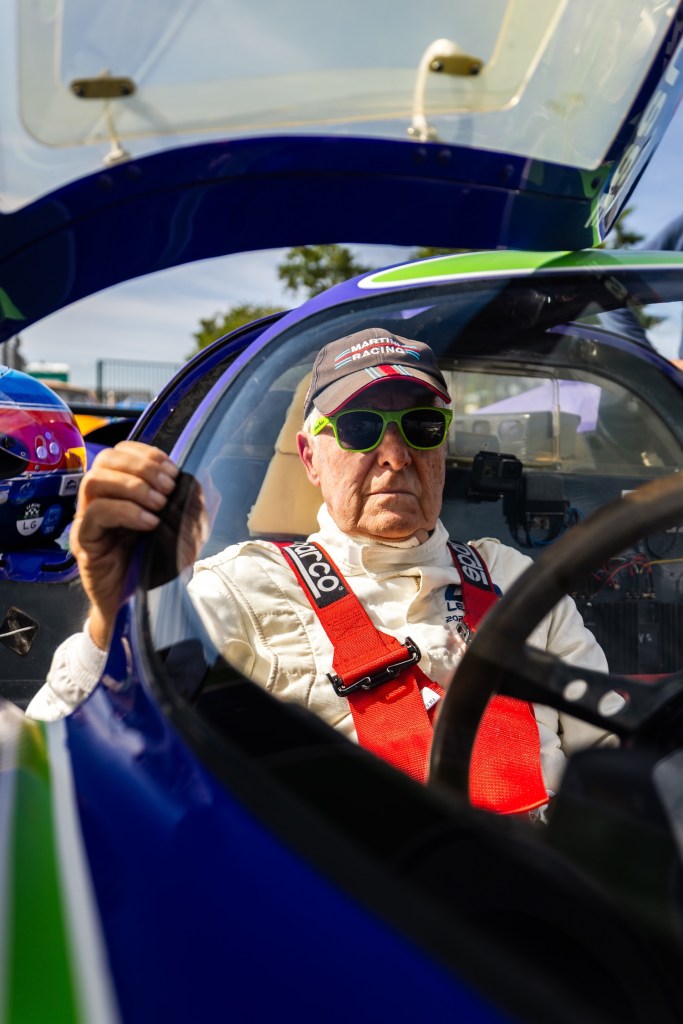
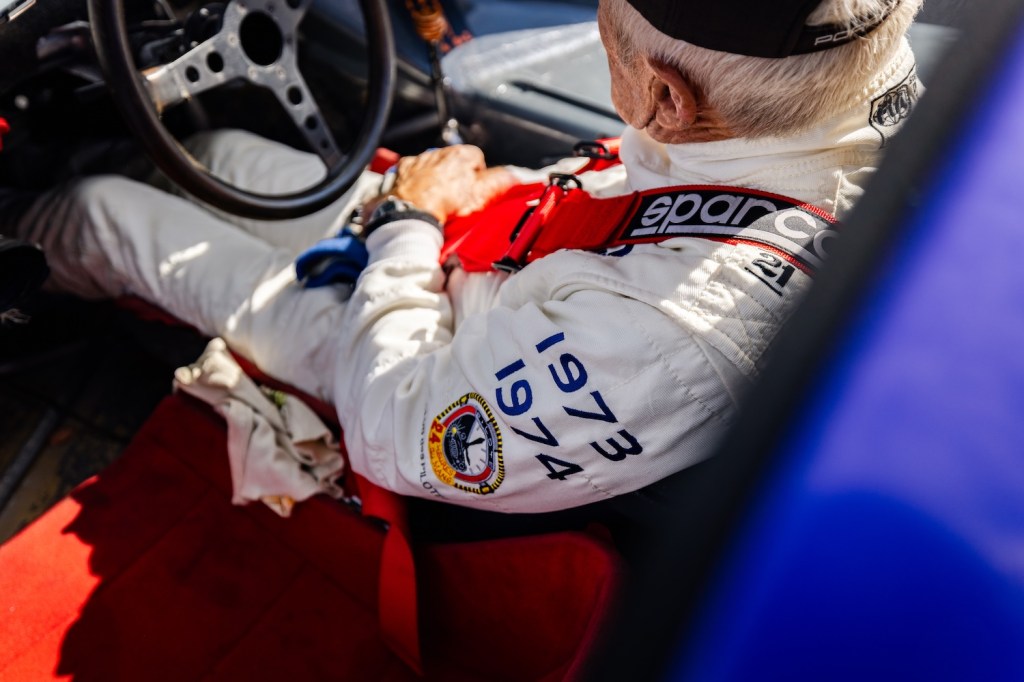
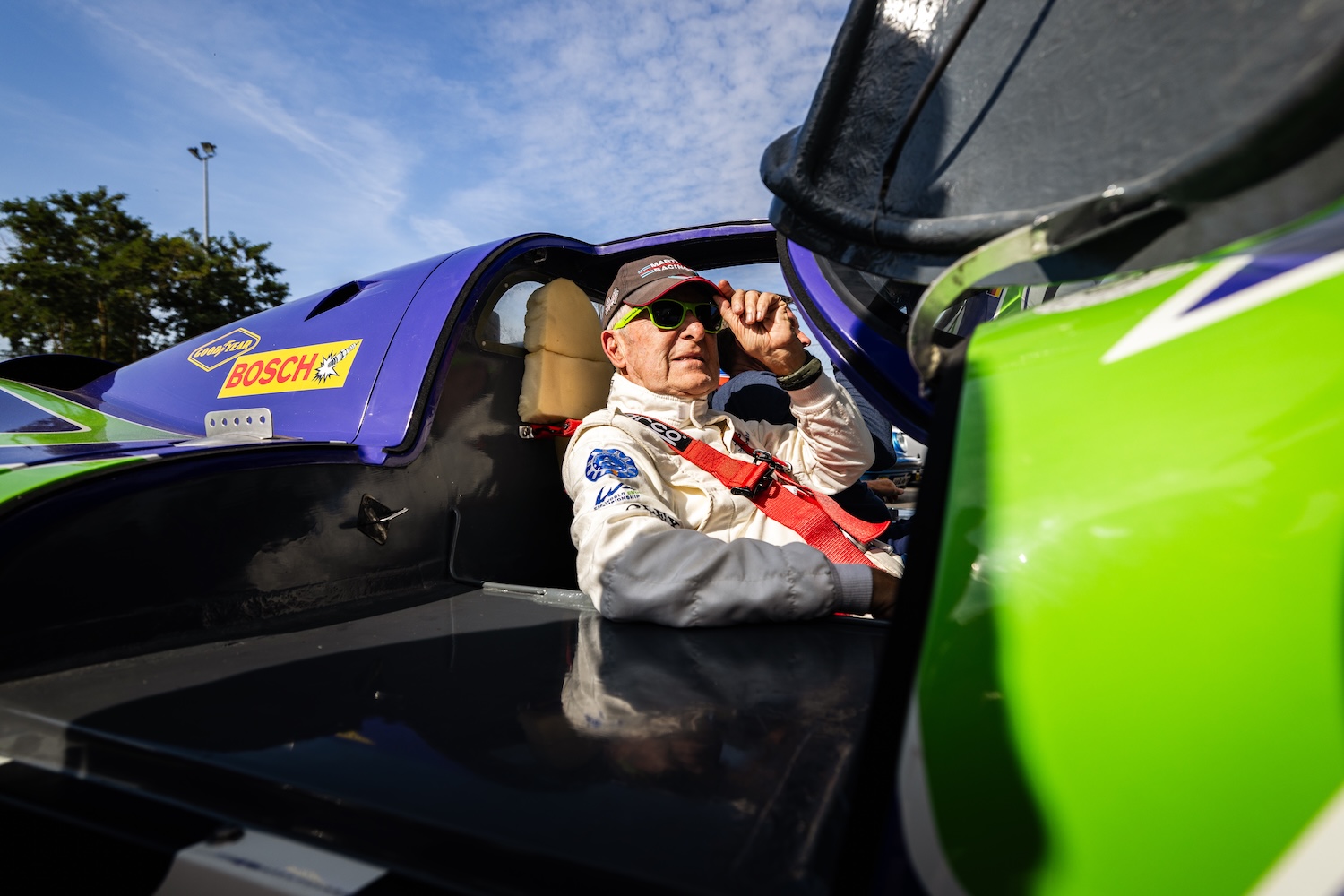
Reunited again with the car, Gérard Larrousse drove 917-043 around the legendary Circuit la Sarthe 55 years since he and Willi Kauhsen drove the car to second overall in the notorious 24-hour race.
The car continues to tour as a monument to Porsche’s milestone motorsport achievement in the 1970s and as one of the most iconic and recognisable collectable cars in history.
All of the information above is corroborated in Porsche factory archive documents, Automobile de la Quest (ACO) documents, the Gulf-Wyer racing team documents, The Christies auction catalogue, as well as the physical evidence observed on 917-043 and 917-044.

Additional information
Locations of the five original SERA 917 Long Tail cars:
- 917-041, Le Mans test car in 1970, owned by collector, O. Boyadjian
- 917-042, Le Mans racer (LM 70 n°25 and LM 71 n°21) now located at Porsche Museum, Stuttgart
- 917-043, Le Mans racer (LM 70 n°3 and LM 71 n°18) in a private collection, UK
- 917-044, unraced reserve chassis, now located in the Simeone Foundation Automotive Museum, USA
- 917-045, Le Mans racer (LM 71 n°17) now located in the Le Mans Museum, France
